
Tahitian Pearls: The Myth of the "Black Pearl" and Its Natural Magic
Discover why they are the world’s only natural dark pearls and the ultimate exotic jewel
If there is one gem surrounded by mystique and legend, it is the Tahitian Pearl. For centuries, the West believed black pearls were an unattainable myth, until the first explorers of the South Pacific discovered these treasures in the lagoons of the French Polynesia.
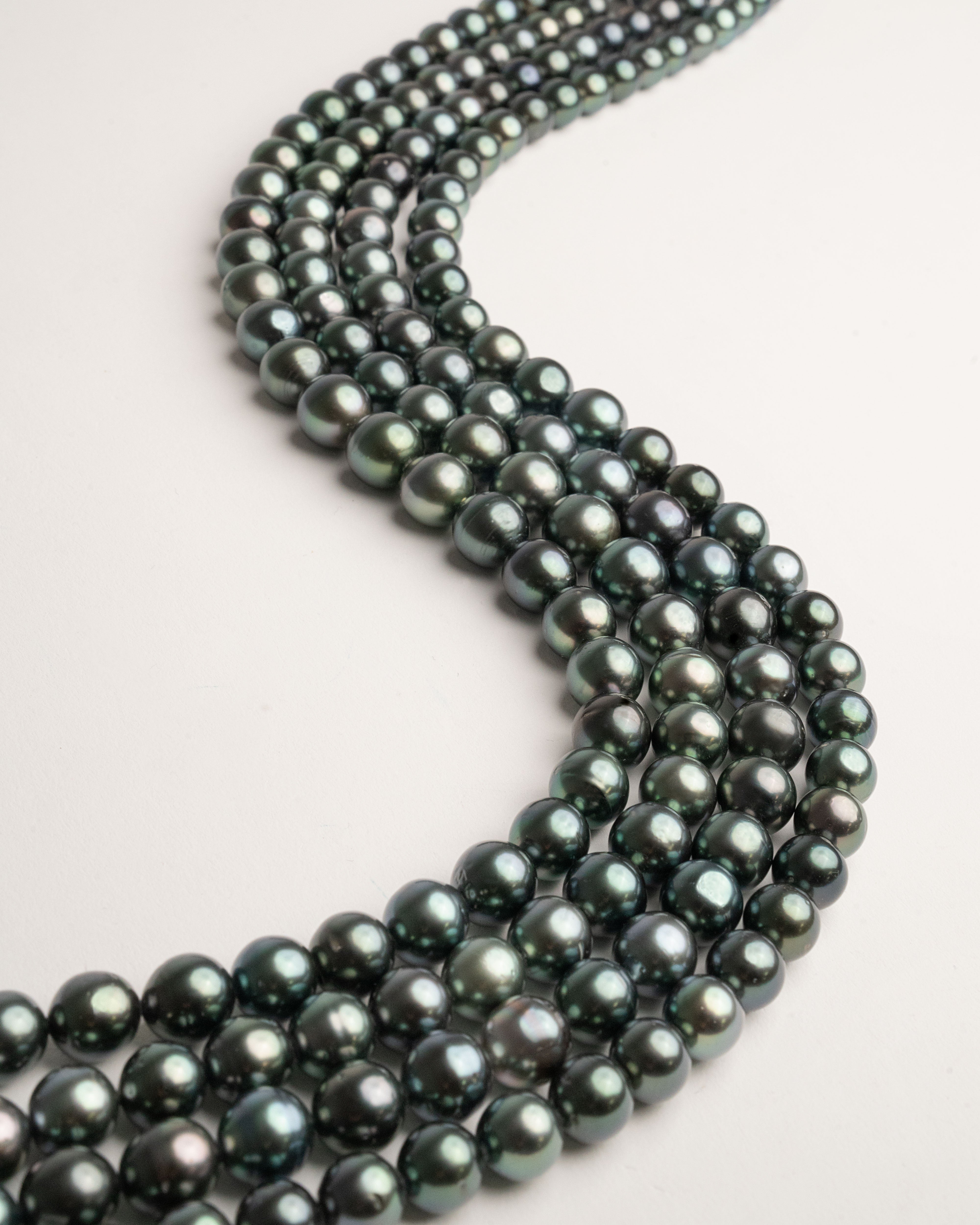
Often they are simply called "Black Pearls," but this name does not do them justice. Their true magic lies in the fact that it is The only pearl in the world that naturally forms in dark tones, without the need for dyes or artificial treatments (unlike the inexpensive black pearls on the mass market, which are usually dyed Freshwater pearls).
Born from the oyster Pinctada Margaritifera (with black lips), a wild mother that gives the gem an unmatched character.
The SY Pearls Quality Guarantee: In our collection, you will only find 100% naturally colored Tahitian pearls. We import them directly, selecting those with the most intense luster and the cleanest surface.
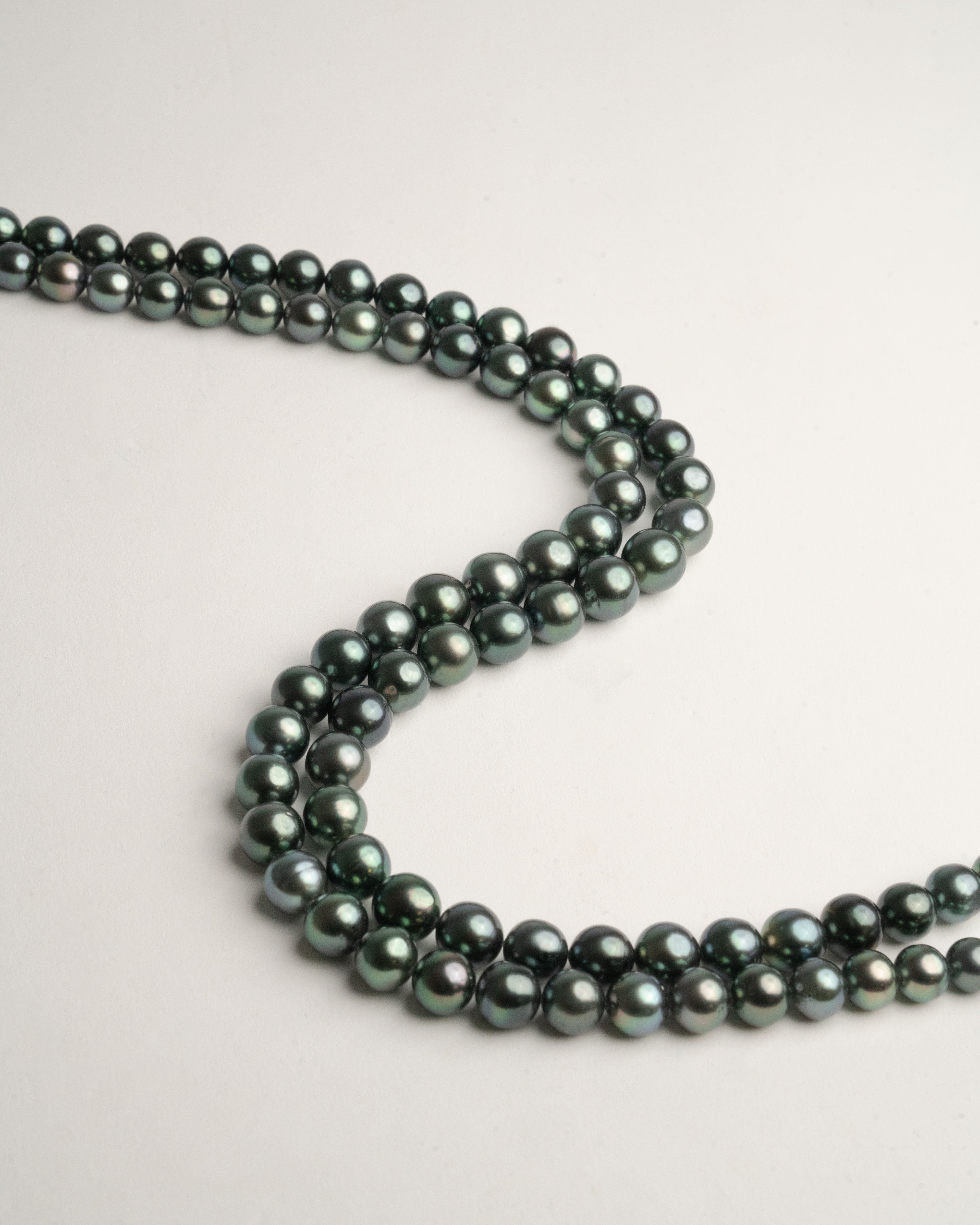
What you see is what you get: We know that buying Tahitian pearls online requires trust, since no two are alike. That's why, at At SY Perlas, we photograph each of our necklaces individually.. When you see a necklace on our website, you are seeing exactly the nuances, tone, and shine of the piece you will receive at home. No surprises or generic photos.
[View Tahitian Pearl Collection]

Cultured Tahitian pearls in one of the oysters that create them
1. The Color: A Rainbow in the Dark
What sets a Tahitian pearl apart is not its darkness, but its light. While other pearls seek uniformity, the Tahitian pearl seeks depth and character. Although the base color is usually dark gray, anthracite, or black, what truly determines its beauty are its overtones (the shades of color floating on the surface).
The range of colors that gifts us the Pinctada Margaritifera is fascinating and whimsical. We can find everything from the coveted Peacock (Peacock) with its green and pink reflections, to shades Eggplant, Intense Green, Bluish or elegant shades Silver.
Our selection: En SY Pearls we are passionate about this diversity. We select our batches always seeking pearls with "life" and an intense luster, regardless of their tone. In our collections, you can find everything from the understated elegance of steel tones to vibrant exotic nuances when the harvest gifts us those little wonders of nature.
[View Tahitian Pearl Necklace Collection]

Tahitian pearl oyster with its pearl in an atoll in French Polynesia
A Necessary Warning: The Case of the "Chocolate" and "Pistachio" Pearls
It’s possible you’ve seen Tahitian pearls on the market in a very uniform chocolate brown color or in very intense pistachio green shades. Here it’s important to be transparent.
During the 2000s, the color "Chocolate" became very fashionable. However, you should know that 99% of these pearls are treated. They are not natural colors. They are often subjected to technical processes (such as irradiation or bleaching) to alter their original pigment and achieve those extreme brown or green tones.
Our commitment: En SY Pearls We stand by natural color. In the hypothetical event that we ever add color-treated pearls to our catalog for their aesthetic beauty, we will indicate it explicitly and clearly. If we say nothing, you can be absolutely certain that the color of your pearl is exactly as it came out of the oyster.
[View Tahitian Pearl Earring Collection]
2. Quality Factors: What defines a "Top" Tahitian Pearl?
In the market, there are many qualities of Tahitian pearls, but at SY Perlas we are not interested in pearls of undesirable quality. When investing in one of these jewels, there are three factors that make the difference between an ordinary pearl and an exceptional one:
The Metallic Luster
This is the hallmark. Unlike the satin sheen of the Australian pearl, a good Tahitian pearl should have an almost mirror-like luster. In SY Pearls We are very demanding about this: the pearl must have "fire." We reject those that look dull or matte. The light should reflect off the surface strongly and sharply.
The Clean Surface
As organic gems born in a wild environment, it is completely natural for the oyster to leave a small "birthmark" on the pearl's surface. Although we look for clean surfaces, At SY Pearls, we prioritize luster. Why? Because shine is what you really notice when you are wearing the jewelry (from social distance). An intense, metallic luster makes the pearl radiate light and visually "hide" small natural imperfections. We prefer a pearl with spectacular mirror-like shine and some natural character over one that is dull and lifeless, even if it is very smooth.

The Form: The Pursuit of Perfection
The oyster Pinctada Margaritifera is a living, capricious organism, so obtaining a pearl perfectly round It is a statistical miracle.
-
Round: They are the rarest and most valuable (less than 5% of the harvest). They represent the safest investment and the most classic, timeless aesthetic.
-
Semirounds and Teardrops: Very popular in pendants, they offer spectacular volume and luster, with a subtle organic shape that reflects their natural origin.
-
Baroque: They are pearls with asymmetrical, free-form, and completely unique shapes. Highly sought after by designers to create jewelry with artistic character, where the imperfection of the shape becomes its greatest virtue.
-
Ringed (Circled): They are characterized by visible circles or lines around their body. This curious phenomenon occurs when the pearl rotates on itself inside the oyster during the creation process. Although they are technically considered a surface imperfection—which makes them more affordable that smooth pearls—, are a very popular option that many customers love for their unique and colorful character. The nuance of quality: No, not all are worth it. The market is full of very low-quality ringed pearls, easy to identify by their deep grooves and lack of luster. In SY Pearlswe only offer ringed pearls if they have spectacular luster and a beautiful color, rejecting those that simply look "defective."

3. Size: Volume and Presence
While classic Japanese pearls (Akoya) barely exceed 9 mm, Tahitian pearls are larger in size. Thanks to the large size of the oyster Pinctada Margaritiferathese gemstones offer a volume and presence impossible to ignore.
-
The Standard (8 mm - 10 mm): The most common and versatile size. Perfect for everyday earrings or necklaces that aim for elegance without feeling heavy.
-
The Presence (11 mm - 13 mm): Here we enter the realm of absolute distinction. A pearl of this size is already considered a significant piece of jewelry ("statement piece") that stands out immediately.
-
The Rarity (14 mm and up): Overcoming the 14 mm barrier while maintaining good quality is extremely difficult. These pearls are scarce and highly prized by collectors.

The Price's "Exponential Jump" It is vital to understand that in the world of pearls, every millimeter counts. The price does not increase proportionally; it rises exponentially. Going from 10 mm to 11 mm does not mean a 10% increase in price, but can actually double it. Why? Because the oyster’s biology makes it much more difficult (and risky) to cultivate a large, perfect pearl than a medium-sized one. When buying a large-caliber pearl, you are paying for that biological rarity.
4. Origin: The Treasure of the Atolls
Although their trade name is "Tahitian Pearls," curiously almost none are cultivated on the island of Tahiti. This island is the central hub from which they are exported, but the pearl farms are scattered across remote atolls throughout French Polynesia, especially the archipelagos of Tuamotu and Gambier.
There, thousands of kilometers from civilization, the waters are crystal clear and rich in nutrients, allowing the oyster to grow healthily and produce these large wonders.

Conclusion: Why choose a Tahitian Pearl?
Choose a Tahitian pearl is to choose the extraordinaryIt is to own the world’s only pearl that is naturally dark, cultivated in the crystal-clear waters of remote atolls where the hand of man barely reaches.
Its value lies in its rarity and its exoticism. Unlike any other pearl, the Tahitian pearl offers a metallic luster and a magnetic depth that draws every eye. It is a piece of jewelry that needs no explanation: its presence alone speaks of natural luxury and exclusivity.
En SY Pearls, we guarantee the authenticity of this experience, bringing from the South Pacific an eternal jewel that will always be with you.
Discover the magic of Polynesia:
[Ver Colección de Perlas de Tahití]